Total Knee Replacement
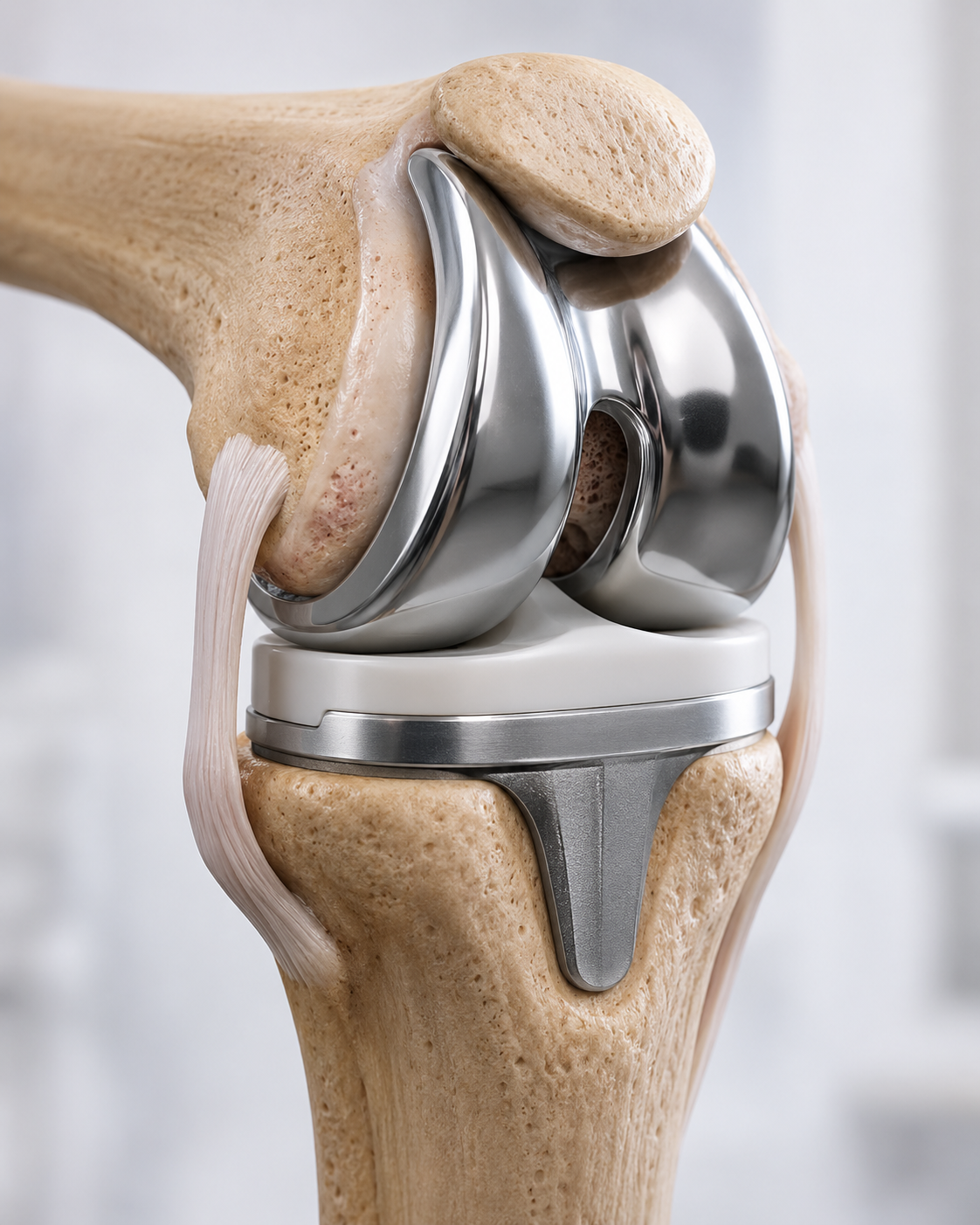
Knee Replacement in Bakersfield, CA
When non-surgical treatments are no longer enough, knee replacement at the Joint and Bone Institute of California can resurface a damaged knee joint and relieve pain that other treatments simply cannot.
Knee replacement at the Joint and Bone Institute of California
At the Joint and Bone Institute of California, we perform knee replacement only after all non-operative treatment options have been exhausted. Also referred to as knee arthroplasty, knee replacement surgery is a last resort — reserved for patients whose knee pain and joint damage no longer respond to conservative care.
The aim of knee replacement surgery is to resurface the parts of the knee joint that have endured damage, ultimately reducing pain that would otherwise not be possible to relieve. The procedure is typically performed while the patient is asleep under general anesthesia. Patients who complete knee replacement patient education classes tend to rebound from the surgery significantly more easily.
When knee replacement is needed.
Knee replacement becomes an option when the knee joint is damaged enough that everyday movement is painful and conservative treatment no longer helps. You may be a candidate for knee replacement if:
- Non-operative treatments — injections, physical therapy, and medication — no longer relieve your knee pain
- Knee arthritis or joint damage limits your mobility and daily activities
- Knee pain interferes with sleep, work, or walking
- Imaging shows significant wear of the knee joint surfaces
What to expect during knee replacement surgery.
Your knee replacement procedure begins with changing into a gown and the placement of an intravenous line in the hand or arm. You are then positioned on the operating table. If there is an abundance of hair at the surgical site, it is clipped away, and an antiseptic solution is applied to the skin before an incision is made.
The surgeon removes the damaged surface of the knee joint and resurfaces it with a prosthesis made of plastic and metal. This prosthesis has three distinct pieces — the patellar component, the femoral component, and the tibial component. Throughout the knee replacement, an anesthesiologist monitors your heart rate, blood oxygen, breathing, and blood pressure to keep you safe.
Knee replacement is always a last resort. Our team exhausts every non-operative treatment first — and we’ll only recommend knee arthroplasty when it’s truly the best path to relief.
Recovery and patient education.
Recovery is one of the most important parts of any knee replacement. Patients who complete our knee replacement patient education classes are better prepared and tend to recover more comfortably. After surgery, our team guides you through follow-up care, wound care, pain management, and rehabilitation so your new knee joint heals well and you can return to the activities you love.
Relieve knee pain with knee replacement.
If knee arthritis is keeping you from the activities you love, the Joint and Bone Institute of California can help. Call us today to discuss knee replacement.